
Anxiety doesn’t always announce itself as a diagnosis. Sometimes it’s jaw tightness at 7 a.m., a chest that won’t fully expand, or a mind that refuses to stop cataloging what could go wrong. At Pulse Acupuncture, it’s the condition Marina Doktorman, L.Ac., encounters most in clinical practice — in every form, at every severity level.
What surprises many patients is that relief doesn’t always require a needle, a prescription, or an appointment. The answer is often simpler: knowing exactly where to press.
This guide covers the most effective acupressure points for anxiety, stress, depression, panic, and headaches — with precise location instructions, technique guidance, and the TCM and neuroscientific rationale behind each point.
Whether you are managing daily stress or seeking grounding techniques during acute anxiety, these tools are available immediately, wherever you are.
What Is Acupressure and How Does It Relieve Anxiety?
Acupressure applies the same theoretical framework as acupuncture, but uses sustained finger or thumb pressure at specific meridian points rather than needles. The distinction matters: this is not general massage or relaxation touch. You are stimulating a precise network of points that influence the body’s regulation of stress, mood, and autonomic arousal.
Understanding why it works requires two frameworks — Western medicine and Traditional Chinese Medicine. Neither negates the other.
The Neuroscience Behind Pressure Points
From a Western medicine perspective, sustained pressure at specific body points activates mechanoreceptors — sensory nerve endings embedded in the skin and fascia. This initiates a neurochemical cascade:
- Release of endorphins, serotonin, and gamma-aminobutyric acid (GABA), the brain’s principal inhibitory neurotransmitter
- Vagus nerve stimulation, shifting the autonomic nervous system from sympathetic dominance — the fight-or-flight state — toward parasympathetic activation
- Measurable cortisol reduction, documented in peer-reviewed research on both manual acupressure and auricular stimulation (Agarwal et al., Anesthesia, 2005)
The physiological outcome is a de-escalation response: reduced heart rate, diminished muscle tension, and a quieter hypothalamic-pituitary-adrenal (HPA) axis — the system responsible for sustaining the stress response over time.
This is not a relaxation effect mediated by intent. Research using fMRI imaging suggests that stimulation at LI4 produces measurable changes in brain activity (Hui et al., Human Brain Mapping, 2000), including regions involved in pain processing and emotional regulation — responses that differ significantly from those observed with non-specific touch.
The TCM View — Qi, Meridians, and the Shen
Traditional Chinese Medicine offers a parallel and clinically useful framework.
In TCM, the body contains a network of meridians: invisible channels through which vital energy — called Qi (pronounced “chee”) — circulates continuously. When Qi flows without obstruction, physical and emotional health remain in equilibrium. When it stagnates, becomes deficient, or moves erratically, symptoms emerge.
Anxiety in TCM typically reflects one of two primary patterns:
- Liver Qi stagnation — frustration, chest tightness, mood instability, and stress that manifests as physical tension. Prevalent in high-demand, high-pressure presentations.
- Heart Shen disturbance — the Shen refers to the mind-spirit housed within the Heart organ system in TCM. When the Shen is unsettled, symptoms include racing thoughts, palpitations, difficulty concentrating, and disrupted sleep.
Acupressure points are selected to unblock stagnation, nourish deficiency, and restore the Shen — addressing not only the presenting symptom but the energetic pattern beneath it.
For patients experiencing persistent or severe anxiety, acupuncture for anxiety addresses these patterns at a clinical depth that self-care cannot replicate. The points below, however, are a meaningful and evidence-informed starting point.
The 7 Best Acupressure Points for Anxiety, Stress, and Depression
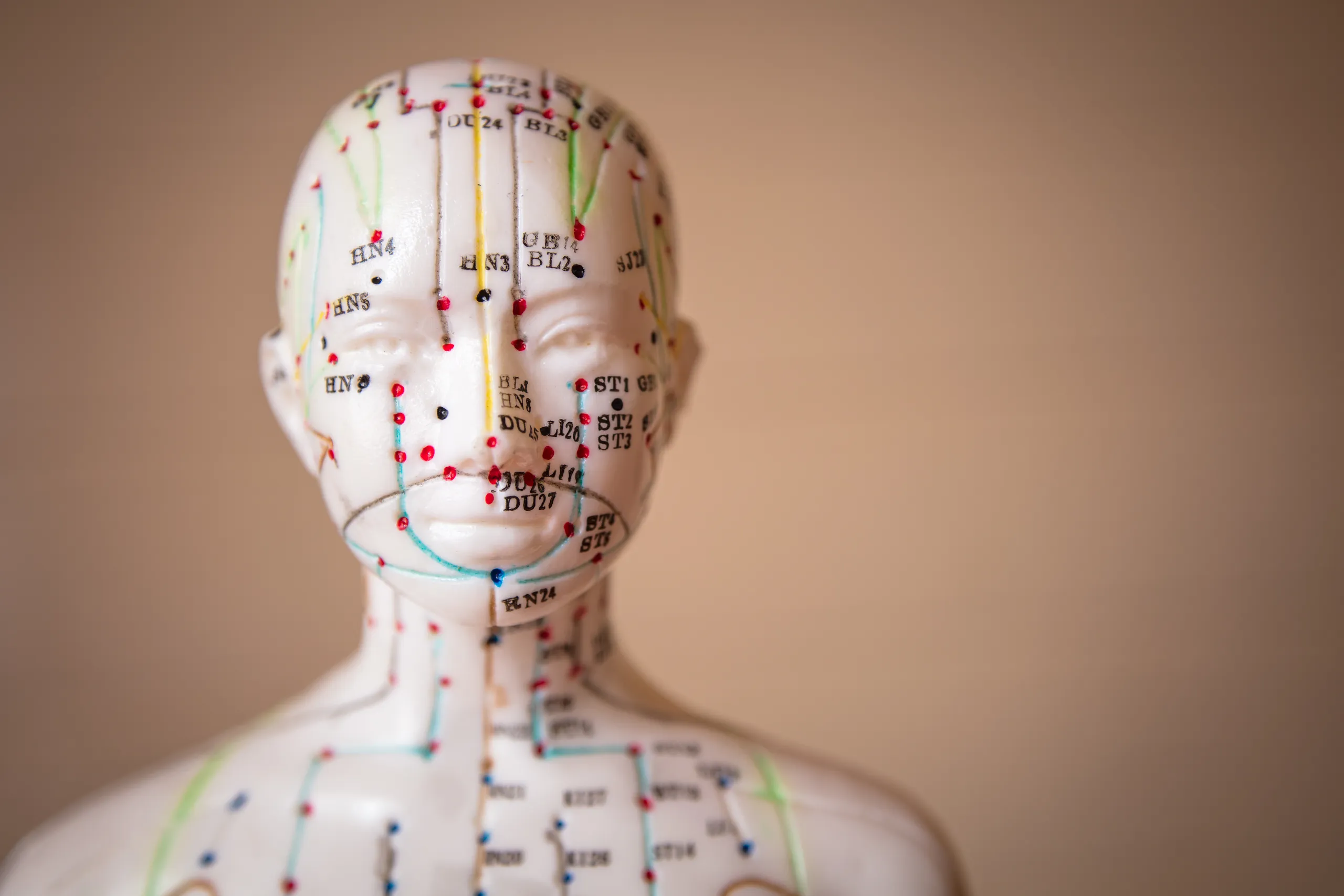
Each point below includes its English name, Chinese name, and standard point code — the notation used by licensed practitioners worldwide. Follow the format consistently: locate the point, apply pressure with your thumb or middle finger, breathe slowly, and hold for the recommended duration.
When you have found the correct point, you will feel a dull ache, mild heaviness, or faint tingling. In TCM, this sensation is called De Qi — your confirmation that you are stimulating the right location.
PC6 — Nei Guan (Inner Gate) · Inner Wrist
- Location: On the inner forearm, three finger-widths above the wrist crease, between the two central tendons.
- Technique: Apply firm thumb pressure in a slow circular motion.
- Duration: 1–2 minutes per side.
- Best for: Anxiety, emotional overwhelm, nausea, and insomnia.
- TCM pattern: Heart Shen disturbance. PC6 is the primary point for calming the Pericardium meridian, which protects the Heart and the Shen from emotional disruption.
- Cautions: None for standard use.
HT7 — Shen Men (Spirit Gate) · Wrist Crease
- Location: At the wrist crease, in the small hollow on the pinky side, just inside the tendon.
- Technique: Apply gentle but firm pressure with your thumb; hold without excessive movement.
- Duration: 1–2 minutes per side.
- Best for: Racing thoughts, palpitations, panic, and insomnia.
- TCM pattern: Heart Qi deficiency. HT7 directly nourishes the Heart and anchors the Shen.
- Cautions: None for standard use.
Note: HT7 shares its Chinese name — Shen Men — with an ear acupressure point covered below. They are distinct points at different anatomical locations. This is a frequent source of patient confusion; both are clinically relevant for anxiety.
EX-HN3 — Yin Tang (Hall of Impression) · Forehead
- Location: At the midpoint between the eyebrows, on the midline of the forehead.
- Technique: Apply light, sustained pressure with your index finger or thumb; close your eyes if possible.
- Duration: 2–5 minutes.
- Best for: Overthinking, worry, stress-related headaches, and difficulty concentrating.
- TCM pattern: Unsettled Shen. Yin Tang is an extra point — not assigned to a principal meridian — but among the most reliably calming points in clinical use.
- Cautions: None for standard use.
This point is particularly effective for patients whose anxiety presents primarily as cognitive — the relentless mental loop that resists interruption. It is also one of the most accessible headache pressure points for tension-type headaches triggered by stress.
LI4 — He Gu (Union Valley) · Hand
- Location: In the webbing between the thumb and index finger, at the highest point of the muscle when the thumb and finger are pressed together.
- Technique: Pinch the webbing firmly between the opposite thumb and index finger; apply sustained downward pressure.
- Duration: 1–2 minutes per side.
- Best for: Tension, frustration, headaches, and physical stress accumulation.
- TCM pattern: Liver Qi stagnation. LI4 moves stagnant Qi along the Large Intestine meridian and has a pronounced releasing effect on upper body tension.
- Cautions: Contraindicated during pregnancy. LI4 has a strong descending and moving action and should not be stimulated at any stage of pregnancy.
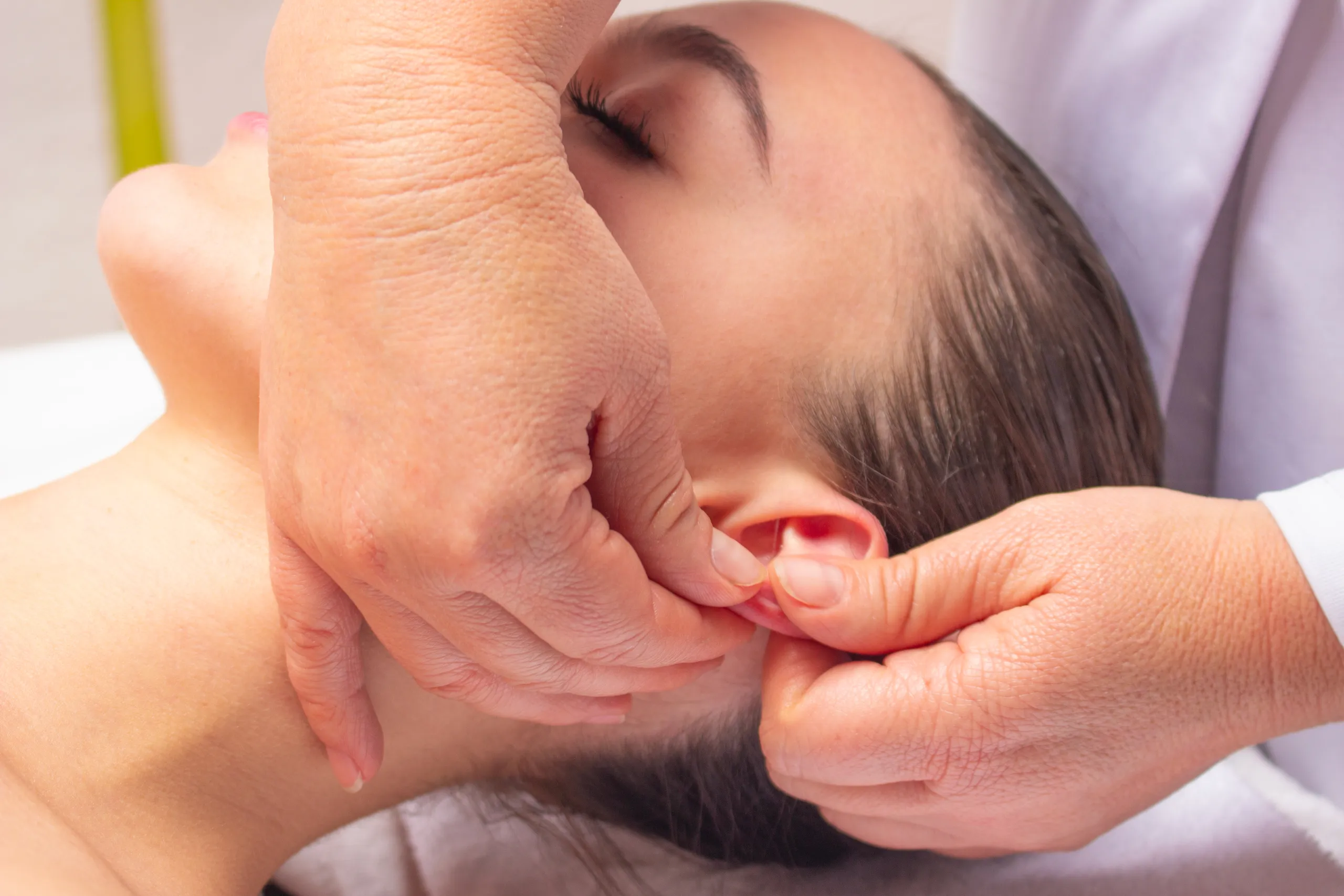
Ear Shen Men · Upper Ear Cartilage
- Location: In the triangular hollow at the top of the ear’s inner ridge (the antihelix). Use a small mirror to locate the apex of this triangle.
- Technique: Apply firm, circular pressure with a fingertip or a smooth-tipped object such as a pencil eraser. Both ears simultaneously, if preferred.
- Duration: 2 minutes.
- Best for: Acute anxiety, acute stress response, insomnia, nervous system reset.
- TCM pattern: Auricular microsystem. The ear maps the entire body in miniature; stimulation at this point corresponds to the Heart and calms the Shen via the auricular branch of the vagus nerve. For a more comprehensive treatment of anxiety through ear points, professional auricular acupuncture addresses the full microsystem with clinical precision.
Cautions: Avoid if the ear has open wounds, active infection, or eczema at the site.
SP6 — San Yin Jiao (Three Yin Crossing) · Inner Leg
- Location: On the inner leg, three finger-widths above the medial ankle bone, just posterior to the tibia.
- Technique: Apply firm thumb pressure directed slightly toward the bone; hold steadily.
- Duration: 1–2 minutes per side.
- Best for: Hormonal anxiety, depression with fatigue, digestive symptoms associated with chronic stress, and insomnia.
- TCM pattern: Spleen Qi deficiency; Kidney Yin deficiency. SP6 is the convergence point of three Yin meridians — Spleen, Liver, and Kidney — making it uniquely suited to patterns where anxiety and depression overlap. If your anxiety presents with persistent fatigue, low mood, or a sense of depletion rather than agitation, SP6 is clinically indicated.
- Cautions: Strictly contraindicated during pregnancy. SP6 has a strong downward and inward-moving action and can induce uterine contractions.
K1 — Yong Quan (Bubbling Spring) · Sole of Foot
- Location: On the sole, in the depression that appears at the upper third when the foot is plantar-flexed. Approximately one-third of the distance from the base of the second toe to the heel.
- Technique: Apply firm thumb pressure or use a smooth object. Can be stimulated seated with the foot resting on the opposite knee.
- Duration: 2–3 minutes per side.
- Best for: Burnout anxiety, fear-based anxiety, acute panic, grounding.
- TCM pattern: Kidney Yin and Yang deficiency. K1 is the most distal point on the Kidney meridian and the lowest point on the entire body. In TCM, Kidney energy governs fear — the emotion most associated with chronic anxiety and existential dread. Stimulating this point, in the most literal clinical sense, is grounding: you are activating the root of the channel that governs the body’s foundational reserves.
- Cautions: None for standard use. Particularly beneficial when combined with slow, diaphragmatic breathing.
Pressure Points for Panic Attacks — What to Do Right Now
If you are in the midst of a panic attack or feel one approaching, the following protocol requires no preparation and no equipment.
Find a surface to sit or lean against. You do not need to be in a special position.
- Locate PC6 on your inner wrist — three finger-widths above the crease, between the tendons. Apply firm pressure with the opposite thumb.
- Begin slow, controlled breathing: inhale for four counts, hold for seven, exhale for eight. Maintain this rhythm while holding the point.
- After 90 seconds, shift to HT7 — the small hollow at the pinky side of the wrist crease. Hold with the same pressure and breathing pattern.
- Finally, bring one finger to Yin Tang — the midpoint between your eyebrows. Apply light, sustained pressure. Close your eyes if the environment permits.
- Remain with this sequence for a total of five minutes, or until the acute response subsides.
This sequence targets the Heart meridian directly, stimulates the vagus nerve through the wrist and auricular pathways, and interrupts the cortisol-adrenaline feedback loop that sustains a panic response.
If panic attacks are frequent, severe, or accompanied by chest pain, shortness of breath, or neurological symptoms, seek medical evaluation promptly. Acupressure is a valuable adjunct to professional care, not a substitute for clinical assessment when symptoms are escalating. Patients managing chronic stress alongside panic disorder often benefit from a structured treatment plan; acupuncture for stress addresses the autonomic dysregulation that underlies both conditions.
How to Do Acupressure Correctly — Technique, Timing, and Who Should Be Careful
Correct technique determines whether acupressure produces a therapeutic effect or simply applies pressure. The following guidelines apply to every point in this guide.
Finding the Right Spot — The De Qi Sensation
When you have located the correct acupressure point, you will feel a dull ache, mild heaviness, or faint tingling beneath the finger. This sensation is called De Qi — a TCM term that translates roughly as “the arrival of Qi.” It confirms that you are stimulating the correct location.
If you feel sharp pain, burning, or no sensation whatsoever, reposition slightly and try again.
- Pressure level: Firm but not forceful. The pressure should feel significant — not superficial — without causing sharp pain.
- Motion: Slow, circular, or sustained static pressure. Avoid rapid rubbing.
- Duration: 1–2 minutes per point, per side, where applicable.
- Breathing: Slow, diaphragmatic breathing throughout. Exhale as you apply pressure; inhale as you release.
- Frequency: Daily use is appropriate and beneficial. For acute symptoms, use as needed.
Full Contraindications — When to Consult Your Doctor First
Acupressure is safe for most adults when applied correctly. The following situations warrant medical consultation before use:
- Pregnancy: LI4, SP6, and GB21 are contraindicated at all stages of pregnancy due to their descending and labor-inducing actions.
- Active skin infection, open wound, or eczema at the point site: Do not apply pressure directly over compromised skin.
- Active cancer treatment: Certain points may be contraindicated depending on cancer type and treatment protocol. Consult your oncologist before beginning acupressure.
- Severe osteoporosis: Avoid sustained pressure over bony prominences.
- Bleeding disorders or anticoagulant therapy: Use only light pressure; avoid deep stimulation.
- Recent abdominal or thoracic surgery: Avoid points in the surgical field until cleared by your physician.
These contraindications are more comprehensive than those listed in most general acupressure resources. If you are managing any of the above conditions, a consultation with a licensed acupuncturist allows for a personalized, clinically appropriate protocol.
Acupressure vs. Professional Acupuncture — And How Home Practice Fits In
A question worth answering directly: if acupressure works, why consider professional acupuncture?
The distinction is meaningful — and not simply a matter of needles versus fingers.
Hand Reflexology vs. Acupressure — Two Different Systems
These terms are often used interchangeably. They refer to distinct practices with different theoretical foundations.
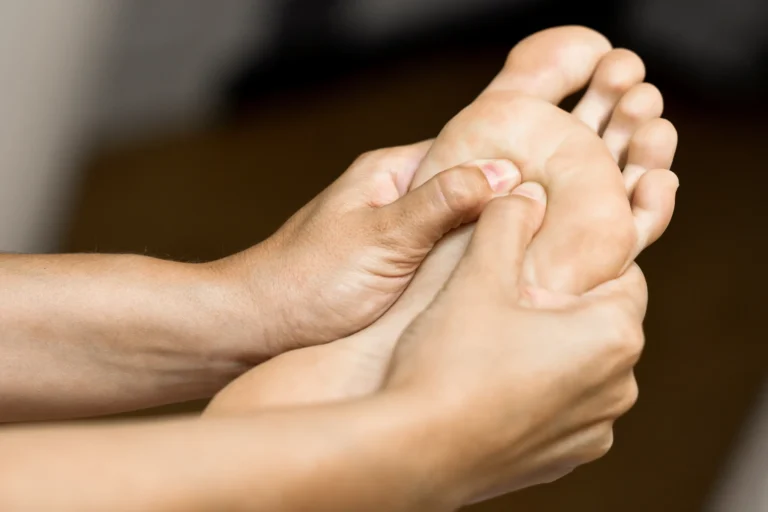
Reflexology — including hand reflexology and foot reflexology — is based on the Ingham reflex zone system, which maps organs and body systems onto specific regions of the hands and feet. Stimulating a zone is believed to influence the corresponding organ through reflex pathways.
Acupressure operates within the TCM meridian system. Stimulation occurs at precise points along specific energetic channels — not zones. The goal is to regulate Qi flow, address pattern-level imbalances, and influence the nervous system through point-specific neurological responses.
Both practices use the hands and feet. Both can reduce stress and promote relaxation. They are, however, different tools built on different maps. Neither is incorrect — but conflating them leads to imprecise application of both.
What a Professional Session Adds That Self-Care Cannot
Self-acupressure at home addresses symptoms. A professional acupuncture session addresses the pattern that generates those symptoms.
In a clinical setting, a licensed acupuncturist can:
- Identify your specific TCM pattern through pulse diagnosis, tongue assessment, and detailed intake
- Select a multi-point protocol targeting the root cause rather than symptom management alone
- Stimulate points at needle depth — reaching Qi at a level that finger pressure cannot access
- Adjust the protocol as your presentation evolves across sessions
“Your daily acupressure practice between sessions genuinely amplifies clinical results,” says Marina Doktorman, L.Ac. “But what I can assess and treat in the room goes significantly deeper — and that distinction becomes most important when anxiety is persistent, layered, or accompanied by other conditions.”
Pulse Acupuncture offers consultations at two locations: Williamsburg, Brooklyn, New York, and Clifton, New Jersey. Both locations serve patients managing anxiety, depression, stress, and insomnia.
FAQ about acupressure points for anxiety and stress
How long does it take for acupressure to work for anxiety?
Many patients notice a reduction in acute anxiety symptoms within 5–10 minutes of correct stimulation — particularly with PC6, HT7, and Yin Tang. For chronic anxiety patterns, consistent daily practice over two to four weeks produces more significant and sustained results. Acupressure is most effective when integrated into a broader stress management approach rather than used reactively.
Can I do acupressure every day?
Yes. Daily use is appropriate and beneficial for most adults. Unlike pharmacological interventions, acupressure poses no risk of tolerance. A brief 5-minute routine each morning or evening — stimulating two to three points consistently — is more effective than occasional longer sessions.
Which pressure point is best during an anxiety attack?
PC6 (Inner Gate) at the inner wrist is the most clinically practical point during an acute anxiety or panic episode. It is accessible and straightforward to locate, and it produces a rapid parasympathetic response in most individuals. Combine with HT7 and Yin Tang for a more comprehensive acute protocol, as detailed in the panic attack section above.
Are there pressure points to avoid during pregnancy?
Yes. LI4 (He Gu), SP6 (San Yin Jiao), and GB21 (Jian Jing) are contraindicated during pregnancy due to their strong descending and moving actions, which can stimulate uterine contractions. Pregnant individuals should consult a licensed acupuncturist before initiating any acupressure practice. Several points in this guide — including PC6, HT7, and Yin Tang — are generally considered safe during pregnancy, but professional guidance is advisable.
Can acupressure replace medication for anxiety?
No. Acupressure is an evidence-informed complementary practice — it is not a substitute for prescribed medication or professional mental health treatment. Patients managing anxiety while relying on medication should continue their prescribed protocol and consult their physician before modifying it. Acupressure functions most effectively as an adjunct: a self-care tool that supports — and in clinical experience, amplifies — the outcomes of professional treatment.